Quantum Computing in 2025: Navigating the Triumphs, Threats, and Transformative Roadmap
Quantum computing is poised to revolutionize industries by solving problems currently intractable for classical computers. We explore the state of quantum in 2025.
Quantum computing (QC) has long captured the imagination, but as we navigate 2025, the reality is a nuanced blend of exponential breakthroughs and critical vulnerabilities. This is not merely a theoretical playground for researchers; physical quantum machines exist and are improving rapidly, ushering in a pivotal moment where vision is slowly giving way to tangible progress.
But what exactly is the state of this revolution? We delve into the race for fault tolerance, uncover critical supply chain risks, and explore how businesses must prepare today to capture tomorrow’s quantum advantage.
The Quantum Reality: Defining the Era
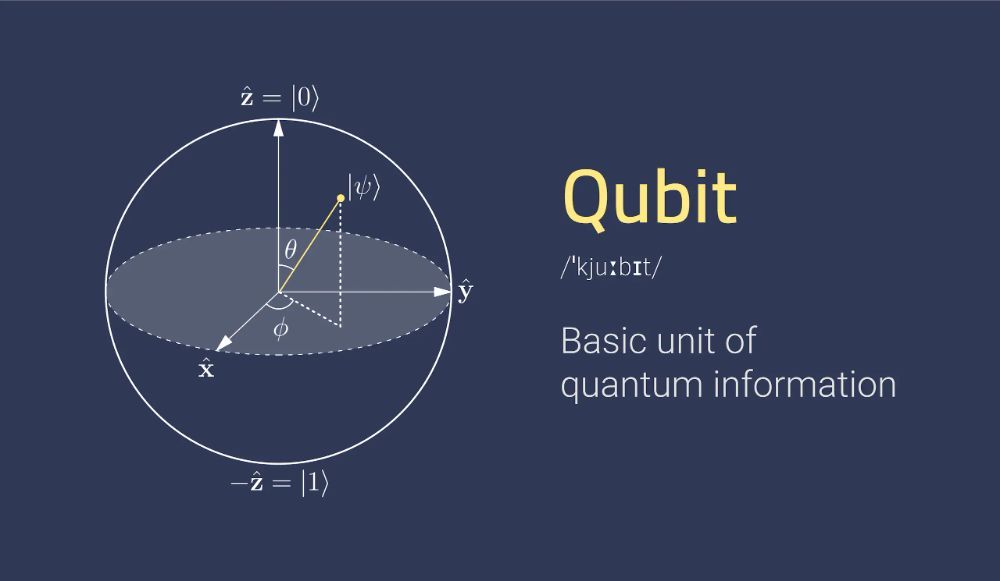
Classical computers use binary bits (0 or 1), while quantum computers use qubits that harness quantum mechanics, allowing them to exist in multiple states simultaneously (superposition) and become interconnected (entanglement). These properties enable QCs to potentially solve problems in optimization, material science, and cryptography far faster than classical supercomputers.
However, in 2025, we remain primarily in the Noisy Intermediate-Scale Quantum (NISQ) era. Current devices are limited in size and prone to errors, meaning practical, everyday applications are still years away, but the foundational work is accelerating.
Measuring the Progress
The industry is measuring performance rigorously, notably through Quantum Volume (QV), a benchmark developed by IBM that accounts for factors like qubit count, coherence times, gate fidelity, and connectivity.
- World Records: Quantinuum’s System Model H2 recently achieved a world-record QV of (8,388,608), fulfilling a five-year commitment to increase their QV by 10x per year.
- Near-Term Advantage: IBM projects that users will start delivering quantum advantage—solving problems cheaper, faster, or more efficiently than purely classical methods—by the end of 2026. This will often involve quantum serving as an accelerator for classical High-Performance Computing (HPC).
- Market Projections: The overall quantum computing market is forecast to grow significantly, projected to surpass US$10 billion by 2045 with a Compound Annual Growth Rate (CAGR) of 30%.
The Race for Reliability: IBM’s Fault-Tolerant Roadmap
Unlocking the full potential of QC requires systems capable of running larger circuits with hundreds of millions of gates on hundreds of qubits, necessitating the ability to correct errors and prevent their spread. This is the pursuit of fault-tolerant quantum computing (FTQC).
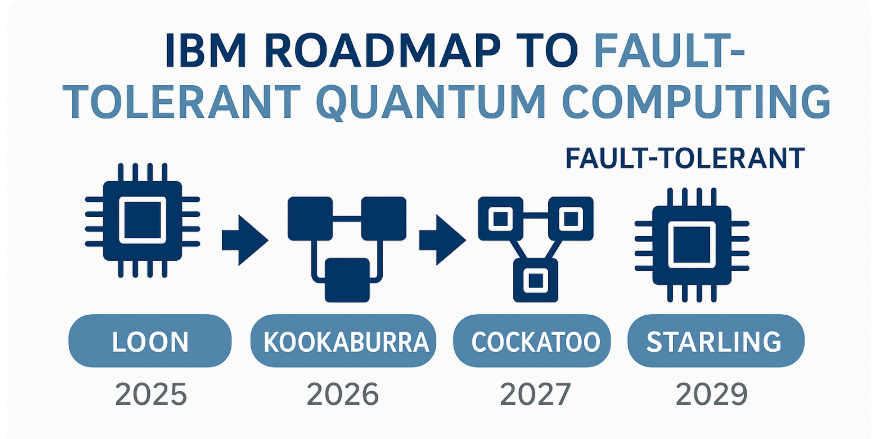
IBM has laid out a clear, rigorous roadmap aiming to deliver the large-scale, fault-tolerant system IBM Quantum Starling by 2029. This system is designed to run quantum circuits comprising 100 million quantum gates on 200 logical qubits. Logical qubits are encoded across many physical qubits using quantum error correction (QEC) techniques to protect information against errors like decoherence and gate faults.
Key elements of IBM’s architecture include:
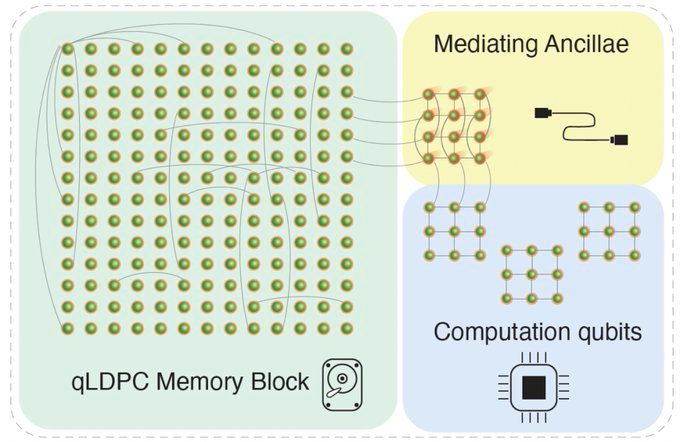
- Bivariate Bicycle (BB) Codes: The architecture is modular and based on BB quantum Low-Density Parity Check (qLDPC) codes. A "gross code" developed by IBM can encode 12 logical qubits into 144 data qubits (a 'gross') along with 144 syndrome check qubits (288 total physical qubits), achieving error correction capability while requiring 10x fewer qubits than the comparable surface code.
- Modular Development: The roadmap involves several critical hardware components leading to Starling, including the IBM Quantum Loon in 2025 (featuring c-couplers for long-range connectivity within a chip), Kookaburra in 2026 (the first module capable of storing qLDPC memory and processing it), and Cockatoo in 2027 (demonstrating entanglement between modules using universal adapters).
- Real-Time Decoding: A crucial component, slated for the Starling proof-of-concept in 2028, is a novel decoder architecture, Relay-BP, which is accurate, fast, compact, and designed to fit on classical Field-Programmable Gate Arrays (FPGAs) or Application-Specific Integrated Circuits (ASICs) for real-time error decoding.

Diving Deep: Quantum Machine Learning in the Energy Sector
The rapid evolution of quantum technology is opening doors to specialized applications, particularly in the energy industry, which faces massive optimization and simulation challenges due to the increasing complexity of power systems and the integration of decentralized renewable sources.
The field of Quantum Machine Learning (QML) aims to leverage the vast computational space of qubits to enhance ML tasks, often utilizing Variational Quantum Algorithms (VQAs) or hybrid quantum-classical architectures.
Early research shows QML focused on high-stakes segments like generation (forecasting renewable volatility) and transmission (ensuring grid stability). Examples of QML applications in this sector include:
- Demand Response: Hybrid quantum agents using QRL (Quantum Reinforcement Learning) have shown they can learn optimal energy-saving policies more effectively than classical neural network agents, potentially achieving a 13.6% reduction in energy consumption in building management.
- Solar Forecasting: Models like QLSTM (Quantum Long Short-Term Memory) embedded with VQCs have been shown to outperform classical models in solar power forecasting, converging faster and showing stronger performance on limited datasets.
- Fault Detection: Hybrid QC-trained Restricted Boltzmann Machines (CRBMs) have been proposed for fault diagnosis in electrical power systems, showing superior performance and halving classification latency compared to classical approaches.
Using a proprietary framework developed by PwC—the Assessment Model for Innovation Management (AMIM)—researchers found that while the implementation feasibility of QML remains low (due to prevalent use of simulators over real quantum hardware), the market compatibility and scalability factors are high. Specifically, applications like power stability assessment and fault diagnosis are ranked as "transformative leaders," indicating high market readiness and significant potential benefit.
The Shadow of Risk: Supply Chain and Cryptography
The transformative potential of QC is matched by profound risks in security and supply chain integrity, requiring strategic international intervention.
1. The Post-Quantum Cryptography (PQC) Imperative
The hypothetical arrival of a large-scale quantum computer capable of running Shor’s algorithm poses a direct, catastrophic threat to modern public-key cryptography, creating the risk of data being stolen today and decrypted later ("Hack Now Decrypt Later").
The National Institute of Standards and Technology (NIST) has been driving a standardization process since 2016 to select algorithms resistant to quantum attacks. Following initial selections (including the lattice-based KEM, CRYSTALS-Kyber, now known as ML-KEM), NIST advanced three final code-based Key-Encapsulation Mechanisms (KEMs) for the fourth round: BIKE, Classic McEliece, and HQC. (The fourth candidate, the isogeny-based SIKE, was broken and eliminated in 2022).
- HQC Selected: NIST selected HQC (Hamming Quasi-Cyclic) for standardization.
- Rationale: HQC was chosen to complement ML-KEM by relying on different, code-based security assumptions. Crucially, NIST found HQC’s analysis of its Decryption Failure Rate (DFR)—the low probability required to ensure IND-CCA2 security—to be more mature and stable compared to BIKE.
- Performance Trade-offs: While HQC has larger key and ciphertext sizes than BIKE (roughly 1.5 times the size for public keys and 2.9 times for ciphertexts), its key generation and decapsulation algorithms are significantly faster, making it a robust choice for general applications.
2. Critical Supply Chain Vulnerabilities
A recent report for the NATO Transatlantic Quantum Community (TQC) identified critical vulnerabilities in the quantum computing supply chain within the Alliance.
The Alliance faces substantial challenges regarding:
- Semiconductor Manufacturing: There are inadequate redundancy and capabilities in the semiconductor manufacturing supply chain (SMSC) and fabrication facilities (SMFF), impacting the ability to scale control systems, ion traps, and specialized quantum chips.
- Exotic Materials: There is heavy reliance on non-NATO sources (often unstable or non-allied regions) for rare earth elements like Erbium (Er) and Ytterbium (Yb), which are vital for quantum components.
- High-Purity Processing: Over 90% of high-purity material processing occurs outside NATO territories.
- Specific Components: The cryogenics field faces long lead times and a limited supplier base for critical components like pulse tubes. Essential materials also include Lithium Niobate (LiNbO3) and specific isotopes such as Silicon-28 () and Helium-3 ().
To address these, NATO recommends strategic initiatives, including coordinating with semiconductor initiatives (involving leaders like Intel and IMEC) and developing domestic capabilities for processing rare earth and exotic materials to secure minimal quantities needed for quantum applications.

Strategic Preparation: The Time to Act is Now
Given the pace of technological change—and the fact that commercial quantum computing strategies take years to execute—waiting for a single technical inflection point is a major risk. Organizations that delay action may find themselves in a "Surprise" scenario where scalable QC arrives sooner than expected, leading to fierce talent wars and significant competitive disadvantages.
Deloitte’s foresight scenario methods emphasize preparing for multiple possible futures:
- Develop a Quantum Roadmap: Organizations must create a roadmap today that identifies potential triggers for action and clearly defines responsibilities at senior leadership levels.
- Educate and Cross-Pollinate: Invest in building expertise in quantum information science (QIS). In the short term, this can involve cross-training AI scientists on quantum mechanics to foster interoperable thinking.
- Experiment Early: Start with small-scale Proofs of Concept (POCs), perhaps focusing on quantum annealing (which specializes in optimization problems) or quantum-inspired algorithms that operate on classical computers but draw on quantum principles. These early learnings are crucial for building institutional knowledge and securing a talent advantage.
- Build the Ecosystem: Begin or continue to advance relationships with quantum computing vendors and public/private partnerships now. As one expert noted, broad adoption is like flipping a switch: it only works if the wiring behind the scenes is already in place.
Conclusion: The Nuanced Revolution
Quantum computing in 2025 is neither pure hype nor everyday reality; it is a critical juncture where ambition meets engineering challenge. From IBM's disciplined push toward fault tolerance using complex qLDPC codes and Quantinuum's proven ability to scale computational power, to the immediate strategic necessity of PQC standards (now featuring HQC) and the critical need to secure exotic materials, the industry is accelerating on multiple fronts.
For leaders, the key takeaway is clarity: the foundational research and engineering needed to participate in this revolution cannot be outsourced or rushed. By developing a strategic roadmap, investing in talent, and closely monitoring the dynamic quantum ecosystem, organizations can position themselves not just to survive the quantum shift, but to delight in the unforeseen advantages it promises to deliver.
Related Articles

Augmented Reality in Everyday Life: Top Applications Beyond Gaming in 2025
Discover how augmented reality is transforming healthcare, retail, navigation, and industry in 2025. Explore real-world AR applications beyond gaming with practical insights.

The Green Revolution: How AI, Sustainable Materials, and New Energy Are Reshaping Our World
Green technology is at the forefront of our battle against climate change. Discover the most promising sustainable innovations of 2025, from carbon capture to circular economies.